
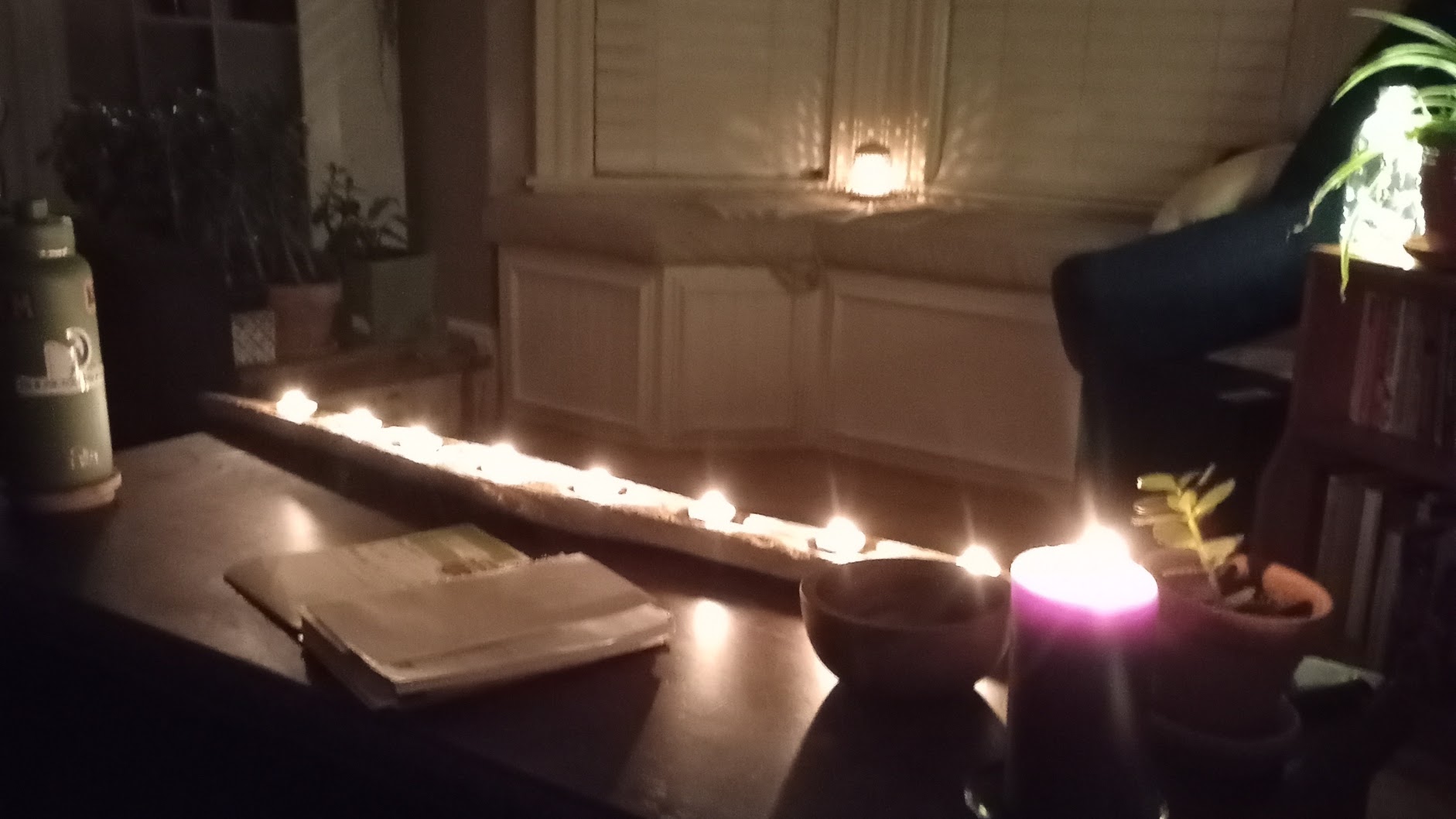
In my last post I wrote about how candles lit the way for me know how to build and nurture better relationships by accepting help and learning to work with others. I also wrote some about the drawbacks of burning scented and paraffin wax candles. In this post I’d like to take a deeper look at what the different types of candle waxes on the market are made from, some pros and cons of each type, and how to get the most burn for your buck, and what I’m burning now. Lets start by taking a look at the effects that burning different wax types have on our health and the environment.
Wax Types, Pros & Cons
In my last post about cleaning soot off my walls I wrote about one of the cons of burning all wax types, the accumulation of soot on your walls. There are a few things happening when you have soot build up as badly as I had. I’m talking to the point where it looks like your room could be a set in a Rob Zombie film. Ok maybe not that bad but one of the reasons I had so much buildup was because I was burning three scented candles at a time in a poorly ventilated room. I went a bit overboard. I also learned that burning certain types of waxes, especially paraffin, leads to soot build up. Let me explain.
The Build Up

I bought my candles from a local discount department store so the candles were cheap which was the main draw. But they were also made from a blend of different wax types, mainly paraffin. According to The Spruce, paraffin wax and gel candles throw the most soot when burned, “Paraffin wax is a byproduct of petroleum and releases soot when it burns, which has raised some questions regarding its effects on the environment.” – The Spruce
A Dishonest Spin on Paraffin
I knew that paraffin wax was made from petroleum but what I learned while researching the best methods to clean soot off walls was that petroleum products produce a lot more soot than other more natural waxes. However I came across a lot of conflicting information about what should be a straight forward answer.
The National Candle Association posted this article 4 Common Candle Myths Debunked on their site depicting paraffin wax in a positive light. “While you may have heard that certain candle waxes burn ‘better’ than other types, this is nothing but a common rumor.” – NCA. With an official sounding name and well designed website I expected them to have some street cred. But how is “burn ‘better” being defined?
For me burning better means a longer, cleaner burn with fewer pollutants. But when I took a closer look at the leadership of the National Candle Association, most of the members were higher-ups in companies like SC Johnson & Son Inc. and The Procter & Gamble Co., as well as other big names in the candle industry. Yankee Candle and Root Candles to name a few. All of which use paraffin as their main wax.
This seems like a conflict of interest in determining what the definition of “best ‘burn’” means, since these companies own candle subsidiaries. SC Johnson & Sons Inc. owns Glade candles, while The Proctor & Gamble Co. owns Frebreze candles. And the other companies, Yankee Candle and Root, are both candle companies. My guess is that they all have a shared and vested interest in putting a positive spin on what they use to make their products. Not to mention it took some digging to find out what waxes they use. Most product descriptions were shrouded in terms such as “wax blend”, save for Yankee Candle who had it printed on their label (at least they’re sort of honest?).
The Science Backed Cons of Burning Paraffin Wax
An article from the Cleveland Clinic says there are moderate risks associated with burning certain types of candles under certain conditions, “these cheaper products (paraffin wax candles) have more formaldehyde-generating materials and a lower melting point. It’s been suggested — but not proven — that cheaper candles are more dangerous because they have more volatile organic carbons in them.” – Dr. Farooq. The doctor also says, “If listed, check the paraffin content of the candle wax you’re considering buying. Whenever you can, opt for beeswax, soy or other plant-based waxes instead.”
Being from Massachusetts, I was a little disappointed by the Yankee Candle Co.’s soiling our good Yankee name by spreading misinformation via the National Candle Association’s agenda. We may be staunch, curt, poor drivers, emotionally reserved, ect… But if it’s one thing we value, it’s honesty. We have a tendency to be blunt, but done so with that oh-so endearing Boston accent (;
The same article from The Cleveland Clinic goes on to say that, “For the safest possible aromatherapeutic adventure, select high-quality candles that don’t use dye or paraffin.” And for reasons of transparency, both websites said that the levels weren’t super dangerous for healthy individuals who burn them in well ventilated areas. But between the environmental impact, the large number of paraffin candles being burned world-wide, supporting the crude oil industry and the possibility of health risks associated with them, why burn them at all? Speaking of the environment if you don’t want to take a doctor’s word for it maybe it would be best to consider the environmental impact of the wax type you burn.
The Greenest Options are Also the Best Options
Paraffin Wax: A Non-Renewable Resource
For those who don’t know paraffin wax is derived from crude oil making it a non-renewable resource. It’s also no secret that other non-renewables include petroleum based products like gasoline and most plastics. I’m not saying that we demonize all things petroleum but we are literally choaking our oceans and wild life with the amount of disposable plastics that are floating around out there. And the sides of our roads, especially in our low-income neighborhoods and cities often look like a landfill which attract pests that breeds disease. I believe we all need to take more responsibility for the good health of our neighborhoods and wildlife by not ignoring the negative impact we have with our consumption of petroleum based products. We can do our part by checking our dependency on these products.
Soy & Beeswax: Renewable Resources
Soy Wax
Candles that are vegetable based are definitely a better choice to lessen the environmental impact. Soy wax candles are made from soy beans, which are a renewable resource. It’s also ideal for making a variety of candle types such as pillar, container and taper. They hold their shape better, have a higher melting point and burn longer, all traits that equal better value.
Beeswax
Another renewable resource along with it being clean burning it’s made by, you guessed it, bees. So not only are you burning a candle that’s wax has been used for literally centuries you’re helping to support bee propagation. You’re also helping local farmers as well as crop diversity and cultivar (plant type) resilience. Also, when burned, beeswax releases negatively charged ions which may help to purify the air. This choice seems like a no brainer.
Other Benefits of Bees
Beeswax is my favorite form of candle wax because it burns longer, and I like honey 🙂 Here are a few of the known benefits of our little pollinator friends and what happens if they aren’t able to do their jobs.
Open Pollinated Seeds – Crops, or cultivars that are open pollenated (by bees or other pollinators like butterflies) are more flavorful, true to type, which means that they are more resilient to their changing environments, and their seeds can be saved from year to year by the farmers that grow them. This allows the farmer to not only grow heirloom varieties, but also not have to buy seed perennially from seed manufacturers. And the farmer has more agency over the variety of the crops they can grow.
Hybridized Seeds – Their hybridized cousins however, are pollenated by human intervention (not bees). With this method, plants are chosen for specific traits. Yield and uniformity are the two main ones, and hybrid plants aren’t as flavorful. Their seeds also have a self destruct button. Their fruits don’t produce viable seeds, and this is why farmers have to buy new seed each season. This impacts the farmers’ income and also drives food prices up.
With climate change on the horizon, it seems to me the most environmentally responsible choice when it comes to burning candles is to pick a renewable wax source. And if you choose beeswax you’ll also be supporting healthier crop diversity and helping to fortify our global food supplies for generations to come. To learn more, go to The Seed Savers Exchange site. They’re an amazing organization dedicated to preserving the integrity and legacy of our seeds and food crops.
Extended Burn Time Equates to Higher Value
And finally, if you’re still not convinced that burning a more sustainable candle wax for your health and the environment is best for everybody involved, maybe the cost will change your mind.
The upfront cost of candles made from paraffin is admittedly cheaper than it’s sustainable counterparts. However, they don’t burn for as long, decreasing their value over the life of the burn.
Below is a video that shows a time lapse of two candles being burned under ideal conditions. The first, a paraffin wax tea light, and the second, a beeswax tea light. Both have a weight of roughly 14 grams, the paraffin candle burned close to 5 grams of wax in 1.5 hours, while the beeswax candle burned close to 3 grams in 4 hours. That equates to roughly 4 hours for the paraffin wax tealight, if the entire 14g of wax was burned, and 16 hours for the beeswax candle of the same weight.
I’m not sure if the numbers are 100% accurate, but from my experience when I’ve burned paraffin wax tealights, they’ve only lasted for one session, which is about 4 hours. And the beeswax candles I am able to burn for about 3 sessions at about 4-4.5 hours a burn. Either way, the beeswax candle burns longer than its paraffin counterpart, regardless of whose numbers you use.
A quick Amazon search tells me that the difference in price between paraffin, 22¢ for one tea light, and beeswax, 60¢ for one, is that the paraffin candle is roughly 1/3 the price of beeswax per candle for a comparable size and weight. But divide the price by the hours burned, and it’s clear which is the better value. The paraffin tealight burns at 5.5 cents an hour (22¢ / 4 hours), where as the beeswax candle burns 3.75 cents an hour (60¢ / 16 hours), making the beeswax candle clearly the better value in the long burn.
So hopefully now that I’ve convinced you that beeswax candles, or plant based ones at least are better for your home, there are a few things you can do to get the most life from your candles. Here are a few pointers I picked up along the way.
Tips & Tricks to Get the Most From Your Candle Burning
I said above that I would tell you what I’m burning. I’m sad to say, that until recently I was burning paraffin wax candles in the name of saving money until I could afford to buy beeswax 🙁 Like I said, I was burning whatever was cheapest. And the beeswax candles I did burn I got from a local seller, Beverly Bees. But they were a little pricey for someone still learning how to live within my means. I’m happy to say that I am burning beeswax again, only this time with candles that I’ve made 🙂 With them costing roughly half the price of one I would buy retail, how can I afford not to burn them. Either way, here are some tricks to get the most from your burn.
Tips for Burning
Initial Burn – Regardless of which type of candle you burn (I hope you chose plant-based), when you’re burning your candle for the first time it’s a good idea to burn it for at least one hour per inch of width. So if your candle is three inches in diameter, you’ll need to burn it for three hours. This is due to the wax creating what is called a memory pool. The memory pool is the liquid wax reservoir that is produced during the burn. If your pool is too small on the first burn, the candle will tunnel.
Fixing a Tunnel – If your candle does tunnel, take a piece of tinfoil, and wrap it around the top of the candle in a cone shape. Leave a hole at the top of the cone, light your candle, and the foil will reflect the heat back onto the candle, melting the thick, outer rim of wax. This will create a level top and restore the memory pool to even.
Proper Wick Length – The common wisdom for wick length is 1/4 an inch. Trimming your wick to a quarter inch will keep the flame at a safe size, and you’ll also get the most life from your candle.
Burn Time – While enjoying your candle, it’s not a good idea to burn them for more than four hours at a time. And this one’s a no-brainer, but keep it away from flammable objects and don’t leave them unattended.
I hope this helps clarify some of the questions you may have about burning candles, wax types, their environmental impact and which companies to support. Whatever the type of candle you choose to burn, don’t forget to enjoy it and relax. Until next time, peace, and thanks for reading 🙂 🏔️🌙🕯️
Leave a Reply