
The inspiration for this post came after I ran out of laundry detergent and needed to make another batch. I started making my own about 2 years ago, but my DIY genesis really began about 8 years prior to me making my own detergent. Before then I had almost zero life skills. Because in my family, the woman’s job was to take care of all things domestic. This included the men, children, cooking and cleaning, and the men were the bread winners. We were a classic case study for Beaty Friedan’s “The Feminine Mystique”, though nobody in my family had been introduced to Friedan’s call for gender equality, or finding work that truly brought us joy. So why all the unrest in my family? I think a lot of it had to do with a fear of breaking free from cultural and gender norms.
Peer Pressure, Gender Roles & Laundry Soap
Peer Pressure
When I was a child, I was taught about the dangers of peer pressure. The focus of these lessons were almost always pertaining to the dangers of drug use and alcohol abuse. But we were never taught about the other, more insidious type of peer pressure. Like slowly spending your way into a boatload of debt and living paycheck to paycheck because you have to buy the next newest and exciting trend. One you may not even like. I’ll get into this more later.
Gender Roles
I’m not sure why it’s so difficult to break free the yolk of gender roles and stereotypes, but for many it’s a difficult battle. My family fell victim to this mindset, and I believe this was due to fear of living a life true to what we enjoyed if what we liked wasn’t inline with our family’s norms, which were the popular opinions regarding social and gender roles at the time. Gender roles were a big deal in the 80’s, so we forced ourselves, and each other with scathing judgements, to adhere to that which made us anxious and fearful. Again, thinking we would be ostracized and ridiculed by our peers if we shared what we truly loved with one another.
Unfortunately this left us chasing the proverbial Jones’s, measuring ourselves to the yardstick of somebody else’s ideal of happiness. No bueno. We felt trapped in the roles we were forcing on ourselves and eachother. Also no bueno. So what does this have to do with laundry soap?
Laundry Soap
The times I felt most contented and at ease as a child were while I was talking on the phone with my friends and playing video games, while my mom was doing laundry in the background. Connecting with people who understood, accepted and liked me, while I was surrounded by the sounds and scents of cleaning, in warm, and orderly surroundings, felt like home. Unfortunately, no one showed me how to replicate these comforts because we still thought house work was the woman’s job.
But luckily for me, I’ve never been afraid to buck social norms. So I taught myself how to make the warm, comfortable home I’ve always longed for. And cleaning, laundry in particular, is an essential element of a cozy home for me. Let’s get into what I’m using for detergent and how you can make your own, and a cozy home on the cheap, using four simple ingredients you can find at your local stores.
Shopping Intentionally for Environmentally Friendly Products
There’s a store which I recently discovered about a block away from my house that I’m super excited about. The name of the shop is Unpacked Living, and their mission is to reduce plastic, and live a zero waste lifestyle by selling plastic free, and bulk items that reduce our dependency on single use plastics. Their mission lines up with my values, so naturally I’ve been shopping there ever since. I don’t need to go over the reasons why we need to consume less plastic, but even though we know how harmful the consequences of using them are, markets like Unpacked Living are in short supple. So it seems that we have no other option but to buy these wasteful products. Or do we? I’ll be focusing on products from Unpacked Living, but you can also find the ingredients to the laundry soap recipe below in most major grocery stores, or better yet, search for a natural grocery by you. So let’s go shopping.
What I love about Unpacked Living is that they have eco-friendly solutions to most of my household needs. This bamboo scraper, an alternative to steel wool or other abrasive sponges, was an excellent and especially satisfying find by my stepmother. If you’ve ever had to scrape hardened food bits off of pots or dishes, you’ll know what I’m talking about. But one aspect I’m most excited about is that they have a bulk dry goods section.
Shop only for What You Need
This is much the same concept as buying bulk produce at your local grocery store. But instead of taking home your fruits and veggies using your own produce bags, which you can also get there, you bring your own containers to take home your dry goods with. Such as the different powdered detergents and cleaners they offer. They also have a bank of free containers too, if you don’t have one or have forgotten yours. And they also happen to have all the ingredients you need to make your own laundry detergent. Borax, baking soda and castile soap, and you can buy them on the cheap. Let’s take a look at some of the benefits of making your own detergent and how you can support a local, small business, while reducing your dependance on plastic at the same time.
An in Depth Look at Laundry Detergents
Takeaway: Powdered laundry detergent is cheaper, and DIY detergent is not only the most cost effective option, but also the most environmentally friendly one as well. I’m using mainly these two sites for comparing the pros and cons of liquid and powdered detergents, How Stuff Works, “How Laundry Detergent Works”, and Swash, “Laundry Powder Vs. Liquid Detergent: Which is Better?”. There are also links to the resources I used for my research at the end of this article.
For transparency, I’m trying to make an argument for homemade powdered detergent being superior because of the financial and environmental benefits, even though both detergents are equally as effective. Also, if you’re not used to critical reading, here’s a guide to help you learn this skill: A Guide to Critical Reading: A Skill for Everyone, Anywhere. This is one of the best skills you’ll ever learn in making informed decisions, and one that was worth the price of my education alone.
The Switch
I switched to using powdered detergent a few years ago to save money while I was paying off $126K in debt and living paycheck to paycheck as I said above, and subsequently needed all the cash I could spare. Luckily, making your own soap has many benefits. The cost being one, but also the environmental impact as well. I knew it to be cheaper, and remember hearing from a trusted source that when you buy liquid detergent, you’re mostly paying for the price to ship the water it’s made with, because you use more liquid detergent than powdered per load. This made sense to me, but I wanted to find a reputable source to explain why this is the case. Lets take a look at some of the pros and cons of powdered and liquid laundry detergents that I found while doing the research for this article, and why I believe that the DIY route is the best option if you value saving money and the environment.
Liquid Vs. Powdered
Liquid
Pro: You can pretreat stains by pouring it directly onto the stain.
Pro: The detergent is already pre-dissolved.
Con: They cost more than powdered detergent.
Con: The plastic packaging isn’t eco-friendly, and may not be recyclable in all areas.
Con: Liquid uses more fuel to ship because you have to use more per load, which means you need more product for the same results.
Powdered
Pro: Costs less than its liquid counterpart.
Pro: Packaging is usually made from paper, which is biodegradable.
Pro: Requires less product for the same results.
Pro: If using homemade detergent, it contains fewer chemicals.
Con: If using store bought, it may contain higher concentrations of harmful chemicals, and may be bad for septic systems and the environment.
Con: Pretreating stains with powdered detergent takes a little more effort than with liquid. You have to make a paste with water first, then apply to the stain.
Considering the Differences
For something we’ve been doing for centuries, there sure is a lot of misinformation on the subject. Much of it due to vague info from experts in the industry, such as trusted brands like Tide. Experts who ideally should have our best interests in mind, and not their bottom lines. Being dissatisfied with the quality of information I was finding, I did some research and found some things to consider when deciding what’s best for your home and laundry needs. Hopefully it’ll shed some clean water on the muddy or untrue information floating around out there.
Cost: Homemade, powdered detergent not only costs less than buying Tide’s liquid counterpart, but also Tide’s powdered detergent as well, using ingredient prices from my local grocery stores with the most reasonable prices, Wegmans and Unpacked Living, also confirm this.
Tide Powder Laundry Detergent, Original Scent from Wegman’s costs $26.99 for 143oz, the equivalent of 113 loads, using 1.27oz/2.5 Tbsp per load, and costs ¢28 per load. One batch of detergent using natural ingredients from Unpacked living and using this recipe from DIY Natural, and Tide’s detergent per load dosage, costs only $22. The recipe yields 146oz, the equivalent of 115 loads, using 1.27 Oz/2.5 Tbsp per load and costing ¢.23 per load. The homemade detergent is $5 cheaper per batch and ¢.05 cheaper per load.* But if we go by Tide’s website and the measuring cup that comes with the packaging, there’s a considerable discrepancy.
How Much to Use?: The answer to this question depends on who is supply the answer. Tide says on their site ,that for their liquid detergent to use between 60ml, little more than a quarter cup or 4 Tbsp, to 90ml, more than a third of a cup or 5+Tbsp. Though when I checked my local grocery store, a 150oz bottle of liquid Tide says that it has 96 loads worth of detergent, which equals roughly 1.5 ounces/3 Tbsp per load. One ounce equaling two tablespoons. Not to mention, why are they using ml as a measurement and not one like tablespoons that their customers are more familiar with?
Further more, when I checked Reddit, one person asked how much powdered detergent to use because their box of Tide Ultra Oxi, powdered detergent says to use half a cup for large loads, or 4 oz/8 Tbsp. Using 4 oz dosage, 143oz yields 35 loads, costing ¢.75 per loads if you’re doing large loads and not 143 loads that’s emblazoned on the front of the packaging. I’m assuming that a large load means filling the machine, which is common practice when doing laundry to save time and utilities. So every load is a “heavy load”, and that’s either $80.97 a year if you go by what’s printed on the box, or $242.81 a year if you’re doing “heavy loads”. That’s a big difference considering that the average home does about 300 loads of laundry a year.
Also, to make thing even more confusing, Tide’s site doesn’t give measurements for their powdered detergent, and instead says to, “just make sure you get the dosage right”. But the correct “dosage” could be anywhere from 1.5oz/3 Tbsp, to 4oz/8 Tbsp depending on where you look and what criteria you use for load size. Thankfully the other sites I researched were all in agreement, saying one to two Tbsp is all you need.
Using More: Tide’s solution to heavier soil levels is to use more detergent, this however, is not necessary. The common wisdom from the sites I’ve found while doing the research for this article, such as How Stuff Works, and Reddit, is that you only need between one or two Tbsp per load. Anecdotally, this is the amount I’ve been using and my clothes come out sufficiently clean.
Hard Water: Tide’s site says that powder detergent does not work well in hard water, and How Stuff Works’ site agrees, saying builders are needed in order for powder detergent to be more effective in hard water. But when I researched builders, I learned that borax, one of the three, main ingredients in homemade laundry detergent, is a water softer. The Spruce says to use a third more borax in the recipe to solve hard water issues, and even with this addition you’re still paying less than if you were to follow Tide’s measurements for detergent amounts per load. Swash’s and Tide’s sites avoid talking about builders entirely. Their solution to manage hard water is to simply use more detergent. Problem solved, but a costly solution.
Septic Systems: Most of the sites I researched agree that powdered detergents can be damaging to septic systems, resulting in a bacteria deficiency, and costly buildup. Though again, while looking into ways to avoid this problem, sites such as EcoCare suggest to use detergents without chlorine and surfactants. Home made laundry detergent doesn’t have either of these chemicals.
Chemical Toxicity: Brand name detergents use many chemicals that are toxic to humans and the environment, according to MADE SAFE‘s website, a company dedicated to promoting safer and greener ways of living. They explain that chemicals such as ethoxylated Ingredients, surfactants, and a variety of undisclosed ingredients, are known to cause cancer in humans, and harm wildlife and the environment.
Knowing what we know and the benefits of making your own, natural laundry detergent, i.e. using ingredients that are safe for people, pets, the environment and less expensive than brand names, you may be wondering “how can I make the switch?” Below is a recipe I’ve modified from DIY Natural’s site, that I’m using in my home, and some tips to help you on your way to DIYing your own detergent.
Homemade Laundry Detergent

⏱️Prep Time:
15 Minutes
🥛Total Yield:
146oz | 292 Loads
🧺One Load=
1 oz | 2 Tbsp
💰Total Cost:
$22
Ingredients
- 8cps | 65 oz, Borax
- 7cps | 55oz, Washing or Baking Soda
- 4, 4oz Bars, Kirk’s Castile Bar Soap*
- 25 – 35 Drops, Essential Oils
Directions
- Using the largest sized holes on a box grater or food processor, grate the bar soap into small flakes.
- Place all ingredients in a gallon container, first the borax, followed by the washing or baking soda, grated soap and the essential oils, if using.
- Cover the container and shake until all ingredients are thoroughly combined. About two minutes.
- Your Laundry detergent is now ready to use!
Notes: I used weights from boxes of Borax: 20 Mule Team 65oz, Arm & Hammer, Washing Soda 55oz, and Kirks, Castile Soap Bars 4oz to get the total yield in ounces. If you don’t have a bulk supply store near you, these products, in the above weights and packages, are easily found at your local grocery store.
*You can sub Kirks bar soap for Ivory Bar Soap, Fels Napa Laundry bar, and Dr. Bronner’s Castile bar Soap.
Tips for Getting the Most From Your Homemade Detergent & General Upkeep for Your Machine
Below are some tips for getting the most out of your detergent and laundry routine, while keeping your machine in good working order. From natural fabric softeners to brightening your garments colors, there’s plenty of info here for you to get the most from your wash.
Cleaning Mineral Deposits: You can flush hard water deposits and mineral buildup by cleaning your machine with vinegar. This will keep your machine running smoothly if you live in an area with hard water, and all you have to do is add two cups of vinegar to an empty machine and run it with hot water for one cycle. This will take care of any mineral deposits or build up and should be done once a month for he machines, or four times a year for top loading washers.
Washing Soda Vs. Baking Soda: Real Simple’s site explains that you can use both washing soda and baking soda as the soda for your recipe, the difference is that washing soda is not as gentile on your clothing as baking soda. I’ve used both, and am opting for regular baking soda to help extend the life of my garments, since my clothes don’t get too soiled. But if your dealing with extra dirty loads, using washing soda may be best for you.
Fragrances: You can add your own natural essential oils to keep your clothing smelling fresh. They’re safer than the questionable ones found in brand names like Tide, and you can tailor the scent to your liking. I like Woolzies Jasmine oil, but find one you’ll enjoy and get creative. Find what makes you feel most at home.
Easy, DIY Fabric Softener: The Spruce suggests that you can use a 1/2cp of vinegar as a natural fabric softer. It’s a cheap and natural alternative to brand name softeners, which are loaded with chemicals.
Measuring Your Detergent: Using a dedicated tablespoon to measure your detergent, one you keep in your container, can help you use the correct amount every time (one to two Tbsp). You can buy one that’s special to you, or repurpose one from an old coffee container, or one you have laying around. Get creative ( :
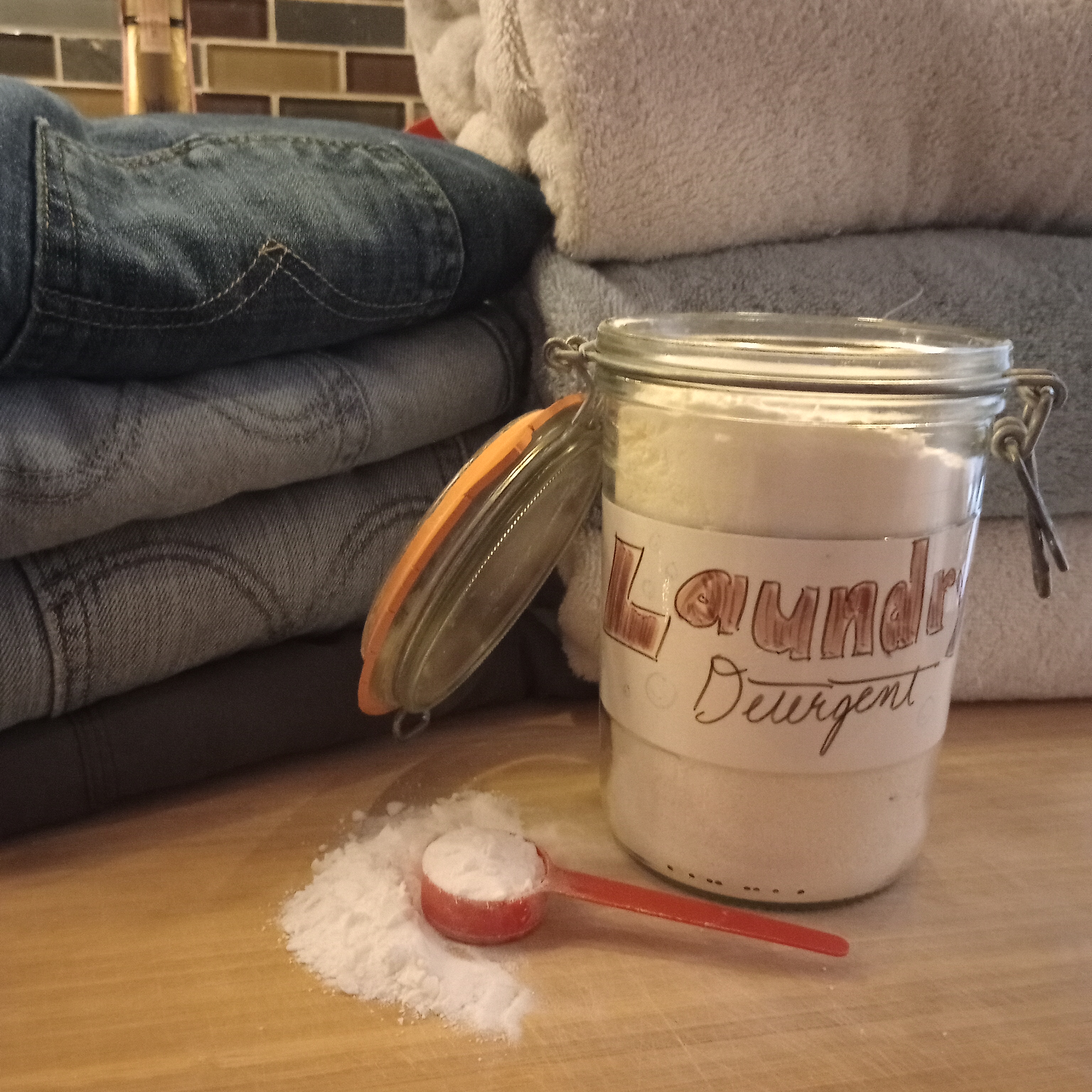
DIY Container: Since we’re making our own detergent, why not make something fun to put it in? DIYing your own container can be a great way to make laundry time visually more pleasing. Here are some photos of the one I made out of an old Le Parfait jar and a label I drew and taped to the front. I get a sense of joy every time I see it : )


Cleaning Up
And that’s it friends. A simple, non-toxic method for making your own detergent that’s environmentally friendly, and a way to support your local businesses. I hope you’ve found this article useful in making your coziest home, and I’d love to hear your thoughts and comments below. And if you feel so inclined, share this recipe on social media. Peace, & thanks for reading 🏔️🌙
- Unpacked Living – Plastic Free Products, Sustainable Market, “Home” Product pricing
- How Stuff Works, “How Laundry Detergent Works” How laundry detergent works and pros/cons.
- Swash, “Laundry Powder VS. Liguid Detergent: Which Is Better?” Pros and cons of laundry detergents.
- Tide, “How Much Laundry Detergent to Use” Detergent amounts per load.
- EcoCare, “How Laundry Detergent Effects Septic Systems” Laundry detergent’s effect on septic systems.
- DIY Natural, “Homemade Laundry Detergent: Best and Natural Recipe” The recipe I’ve modified for the detergent I use.
- Real Simple, “Washing Soda Vs. Baking Soda: What’s the difference?” The difference between washing and baking sodas.
- The Spruce, “The Best Way to Solve Hard Water Problems” Avoiding hardwater buildup and using vinegar as a fabric softener.
- The Spruce, “Yes, You Can Clean Your Washing Machine Using Just Vinegar, Here’s How” How to clean mineral deposits in your machine.
- Wellness Mama, “How to Deep Clean a Washing Machine | Naturally” How to deep cleaning your washing machine.
- NBCDFW, “How Often Do You Need to Wash Your Stuff” Average number of loads one family does annually.
- Medium: “A Guide to Critical Reading: A Skill For Everyone, Anywhere” Learning critical reading skills.
- Reddit R/Frugal: “How Much Powder Laundry Detergent is Necessary?” Detergent amounts per load.
- Instacart, “Wegman’s, Tide Powder Laundry Detergent, Original Scent” Tide product cost.
- MADE SAFE, “Viewpoint | Product Profile: Laundry Detergent “ Health and environmental impact of chemicals found in brand name detergents.
- Le Parfait – Preserving What’s Best, “Le Parfait America” Jar I used for my DIY detergent container.
*I took Tide’s suggested detergent measurements per load as a control and used the same measurement per load for the homemade detergent. To determine the price per load, I took the price from Tide’s product, Tide Powder Laundry Detergent, Original Scent, at $26.99 at Wegman’s, and divided that by 113 loads, the number of total loads printed on the packaging, to get the price per load of ¢23. To get the detergent amount per load, I took the total weight of Tide’s product, 143oz, and divided that by the number of loads the box contains as printed on the packaging label, 113 loads, to get the amount of detergent used per load, which is 1.27oz. One ounce equals two Tbsp, dry or liquid.
Leave a Reply