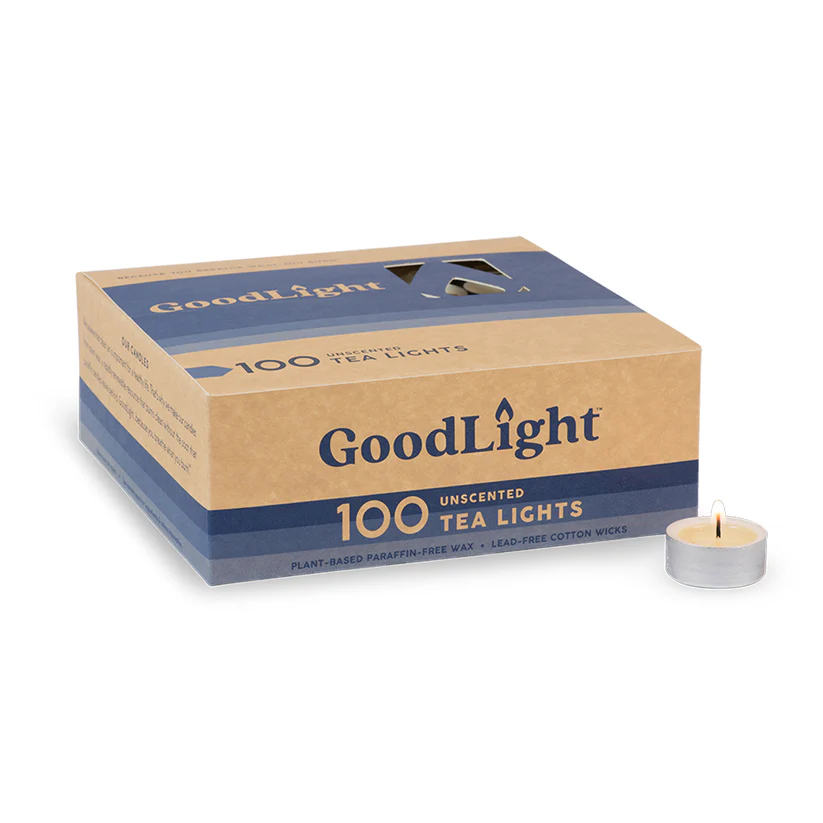
This post is about The GoodLight™ tealights, and why they’re my go-to candle. But before I get into why, let me explain how I came to this decision. If you read my post on cleaning soot from my walls, you’ll know I used to burn paraffin wax candles regularly. I bought them at a local off price department store, all different scents and brands, and burned three or four at a time. The smell was terribly overpowering. I found out later that the reason they were so cheap was because they’re made from paraffin wax, which is derived from petrochemicals, i.e. oil. I did however learn how to clean soot off my walls, and that their wooden tops can be used for coasters. So I’ve got that going for me.
But since I’ve stopped burning paraffin, I needed to find another wax type to burn. Below I’ll be sharing my research and the reasons why I’ve decided to go with The GoodLight™ sustainable palm wax tealights, and hopefully shed some light on your candle purchasing preferences. Let’s start with the different styles available.🕯️
Candle Styles
GoodLight™ candles come in a variety of shapes and sizes. Below is a list of the most common types that can be found at Unpacked Living, and most retailers who carry ethically sourced candles.
- Tealight – The smallest candle on the list, tea lights are about 1.5″ wide by .5 ” tall, with a burn time of about 4 hours.
- Votive – Votives are usually about 1.5″ wide by 2″ to 3″ tall, and have a burn time of approximately 10-15 hours.
- Taper – Taper candles average 7/8″ wide by 10″ tall, and have a burn time of roughly 7 hours.
- Pillars – The average pillar is about 3″ wide by 6″ tall with a burn time of 60 to 80 hours, but can range in height, circumference and burn times significantly allowing you buy what’s right for your needs.
Palm Wax, Pros & Cons
All candle styles are available in different wax types, scents, shapes and sizes, so you can tailor them to your situation and needs. If you’ve smelled it, they’ve probably made a candle that smells like it. I’m assuming that most people are well informed on why using paraffin wax or petroleum based products is none of the buenos. So let’s take a look at the pros and cons of sustainable palm wax and why I’m choosing to burn it over other options.
Pros:
Palm wax is derived from the palm fruit of the oil palm tree making it plant based and renewable. The oil palm tree is one of the most prolific producer of oil used for human consumption, and according to the World Wildlife Federation (WWF), in order to obtain the same amount of oil from other wax producing plants, you would need 4 to 10 times the amount of land. That includes soy, coconut, sunflower and rapeseed oils. That’s a lot of land.
As well as being prolific producers, sustainable palm oil has allies who are environmentally focused. The Roundtable on Sustainable Palm Oil (RSPO) is helping to make palm oil more sustainable by certifying oil palm tree plantations, who are using ethically sound production methods. Some of the criteria to gain certification by the RSPO are: plantations must exist on land already growing oil palm trees, an attempt to stop slash and burn practices. Plantation owners must have the rights to use the land, and growers must maintain the good health of the soil and water used.
Cons:
Burning palm wax isn’t the main concern for most critics of the palm oil industry. What they take issue with is how it’s harvested, and the sustainable farming practices of the palm oil trees.
Organizations like Green Peace and Ethical Consumer criticize the RSPO certification for not meeting their own (RSPO’s) standards. They’re important ones too. Protecting the endangered orangutan population and child labor laws to name a few. They’re also concerned that using certifications like the RSPO’s will green wash palm oil products. All valid concerns.
Conclusion:
Standards are good to have, no ones questioning that. But what I think organizations like Green Peace often fail to see is that people aren’t perfect. This means that people can’t perfectly meet the standards we make. Rather they are codes of conduct that we will hopefully achieved. So, if a company is only 10% compliant with a certification, and your only other options are companies with a 0% compliancy, then asides from growing and processing your own palm wax, the 10% compliant company is your best option.
If we stop criticizing each other for not being perfect and accept progress as the benchmark for our decision making, then I think we’ll all feel more empowered and confident in the choices we make. And shopping local helps me make these types of decisions. I started getting them from Unpacked Living, my local, sustainable home goods store where the owner, Sabrina, has taken the time to research the products she carries. So, I’m not only supporting local, I’m also having the research on the products I’m purchasing done for me, by the shop owner I know and trust. That’s accountability.
Burning Basics
Regardless of which candles you chose to burn, here are a few suggestions to keep in mind while enjoying the ambiance of your serenely lit space.
Trim the Wick: Ideally your wick should be at about a 1/4″ long. The reason shorter wicks are better is due to the amount of wax being consumed. If your wick is 1/2″ long, then it holds twice as much wax as a 1/4″ wick does. This means your candle is being consumed twice as quickly. And a shorter wick also correlates to less soot being thrown into the air.
As the wick is consumed, the ash, mixed with non-combustible oils, become aerosol and sticks to the surfaces in your home. Break out the shaving cream and sponge (;
Burn Time: A good rule of thumb is to burn your candle for at least as many hours as there are inches in its diameter, in one session. So if you have a three inch diameter candle, burn it for three hours at a time, until the wax melts completely to the edges of it’s votive. The melted wax is called a memory pool, which is the liquified wax from previous burns, hardened. Ideally the memory pool will encompass the entire candle’s surface, ensuring an even burn and the entire candle will be consumed which means you enjoy every hour your candle has to offer. But if you don’t burn completely to the candle’s edges, there will be a ring of unmelted wax surrounding the memory pool, which the candle won’t melt past in future burns. This is called tunneling. There are ways to fix it if this happens to you, but it’s best to avoid it if possible.
Making The Switch & Loving Myself A Little More For It
Now, self-love or self-care has become a fad. One that’s passed its coolness factor much the way people have switched from Yeti mugs to Stanley Cups. It was a talking point. Something to feel like you’re in the know, hanging with the cool kids, the crėme de la crėme. But self-care for me was thankfully something that stuck.
Candles were one of the first ways I learned how to practice self-love, when I cast a love spell using a candle I bought in Salem MA as a teenager. It was a red pillar candle, and I believe it had a charm on, or in it. A couple of friends and I cast the spell in a park I used to play in as a child. I see now that I was looking for simpler times, when I felt safe and secure. My life was chaotic then and I didn’t know where else to turn to for love.
Now, burning a candle before bed is an essential element of my nightly ritual. Something that does more then just shed light on my daily wind-down routine. They create a sense of comfort and ease. A little piece of that night I cast my love spell. The memory of looking back over my shoulder at the blanket of snow, with the candle’s faint glow being cast by its flickering flame, brings me a sense of warmth and comfort. Something I create each night I burn a candle. My own little love spell. I’ll leave you with a song that’s one of my favorites and on brand with this post, and hopefully, I’ve helped you find an element of your own little love ritual. Peace & thanks for reading :)⛰️🌙

Leave a Reply